One Waltz for the Whole Film
Just before a school film club’s silent comedy premieres, Nina discovers she is expected to supply twenty-seven minutes of music. She confidently remembers one waltz.
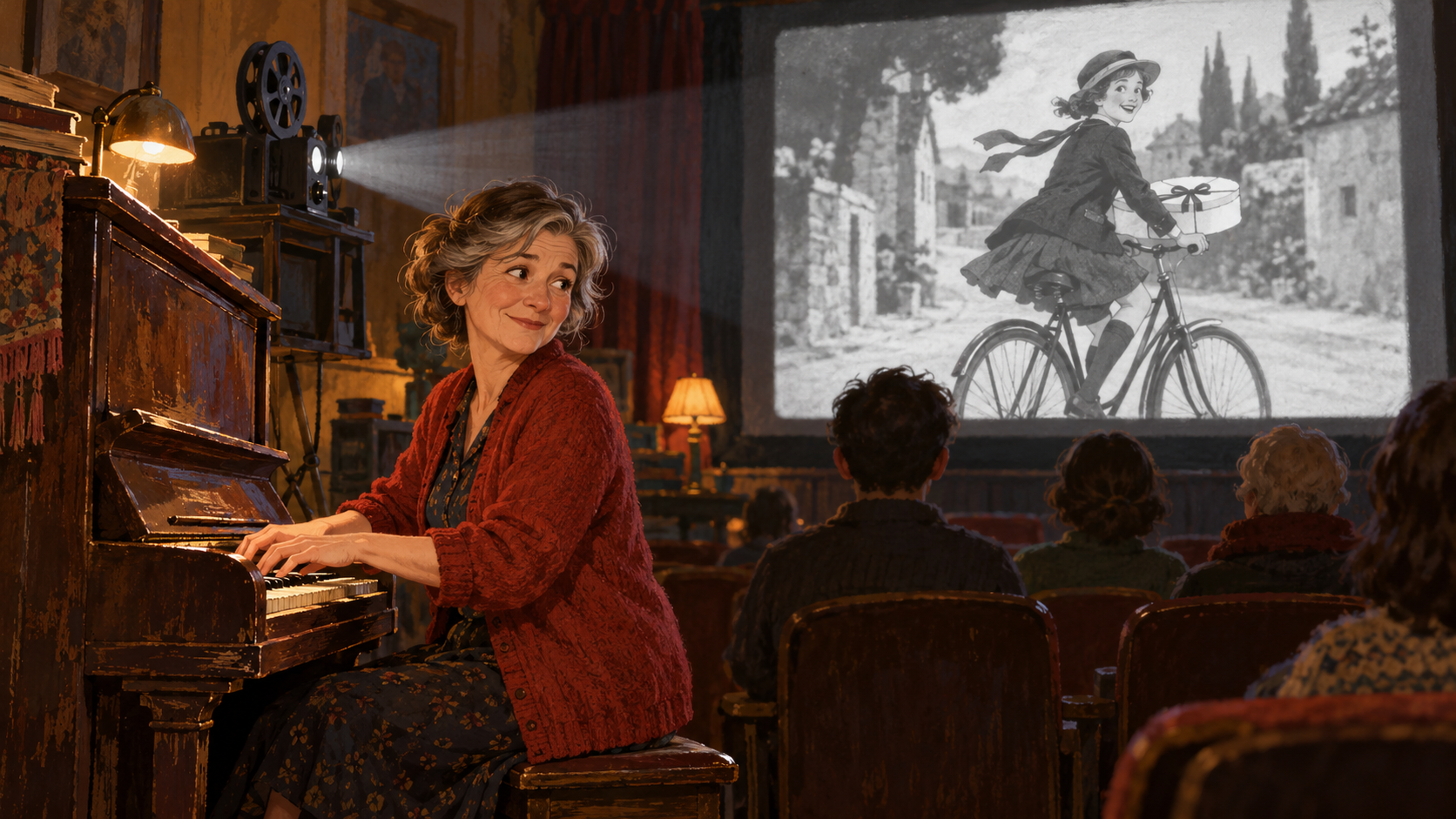
At the Lighthouse cinema
Nina found herself on the poster between the film title and the words “Live Musical Accompaniment.” They had spelled her surname correctly. That was the worst part: she could hardly claim they meant another Lobanova.
“Grisha,” she said through the ticket window. “We agreed on three minutes.”
The top of a head appeared, with a pencil sticking out of its hair.
“While people are taking their seats,” Nina clarified. “Before the film.”
“I thought you meant you’d start while they were taking their seats. Mum!”
Tickets rustled behind him. Grisha’s mother, who was also the manager of the Lighthouse cinema, pushed a saucer with two boiled sweets through the window.
“How long is your film?” Nina asked.
“Twenty-seven minutes. Including the credits.”
She took one sweet. Twenty-seven minutes was nine of her performances at the library’s holiday party. At those, though, she only played the waltz once.
Nina had composed it at fifteen and called it “First.” There had never been a second: exams came first, then work, and whenever she moved house her music notebook went underneath the crockery. She remembered all three pages, including the place where her teacher had written “Do not rush” in red. Everything else from her school repertoire began confidently and petered out around the ninth bar.
People were already seated. Fyodor from the repair shop had brought his wife a cushion for the hard chair. The chemistry teacher was trying different pairs of glasses from her pockets. Asya, the leading actress, hovered by the front row with a real round cake box.
“For afterwards,” she told Nina, pressing the lid down.
The piano stood to the left of the screen. A flowerpot had left a dark ring on its lid; the end key was the colour of old cream. Nina sat down, put her bag between her feet and tried the pedal. It gave a metallic sneeze.
Grisha peered out of the projection booth. She could still wave, get up and go back to the library. Three boxes of new books were waiting there, none of them making any musical demands.
Instead, she turned to the audience.
“There’s a slight mistake on the poster. I only have one waltz.”
“A good one?” Fyodor asked.
“I wrote it ages ago. It’s had time to settle.”
Fyodor nodded as though they were discussing a plank. The lights went out.
“Delivery,” a silent comedy by the school film club, appeared on the screen. Grisha had spent all summer shooting it. Wearing an oversized jacket, Asya cycled out of the bakery with a box bouncing on the luggage rack. Nina played the opening chords.
While Asya rode along the waterfront, everything went beautifully. Gulls flapped in time. Then a dog shot out of a gateway.
Nina sped up. Asya pedalled harder, the dog raced after her, and the waltz broke into a run. In the sixth bar Nina missed two notes. The dog happened to leap a puddle. A short laugh came from the third row.
Next came a yard strung with washing. Asya ducked under a sheet, emerged wearing a pillowcase and headed straight for a man carrying three empty crates. The waltz ended.
Nina immediately began again, an octave higher.
The crates flew. A title card appeared, taking its time: “I rang!” Asya displayed a bicycle bell with no clapper. Everyone laughed, including the real Asya by the front row. Nina smiled without looking up from the keys. Her ring was catching the neighbouring key; she slipped it off with her left hand and put it inside the flowerpot mark.
Over the next quarter of an hour, the waltz visited the market, rode in a handcart and returned to the waterfront three times. Then Nina lost count.
Around a corner, Asya stopped to adjust the box. The bicycle tipped. The lid opened just as Nina reached her grandest chord.
The cake slid slowly onto the pavement.
The chord was magnificent. Nina felt awkward.
On screen, Asya sat on the kerb. She lifted the cardboard cake board with its squashed icing rose and checked her watch.
Nina prepared to start the waltz again—and took her hands away.
A chair creaked in the silence. Someone crumpled a sweet wrapper and stopped halfway. Asya sat with her elbows on her knees. Nina had never noticed how pointed the girl’s elbows were. At the library, Asya was usually at the desk asking when the next detective book would be returned.
The dog entered the frame. It sniffed the cake and sat beside her. Asya pulled the surviving slice closer. The dog looked away with such dignity that Fyodor gave a quiet snort.
Asya took a single candle from her pocket, stuck it in the slice, carefully put everything in the box and stood up.
Nina found the first three notes. She played them softly, without her left hand.
In the last scene, Asya entered the repair shop. Behind the workbench sat Fyodor—the real Fyodor, only in his summer vest. He took off his safety glasses. Asya opened the box. He looked at the crooked slice, then at her, and took two small adjustable spanners from a drawer. They ate the cake with those.
Nina finished the waltz with the credits. The pedal sneezed again. This time it fitted.
When the lights came up, Grisha was already beside the piano, holding his phone in both hands.
“I recorded the sound. Can we keep it?”
“You can hear the pedal.”
“Especially the pedal.”
Asya opened her real box. Inside were a whole cake and a packet of wooden forks. Fyodor picked up a fork, turned it over and said the tools in the film were more reliable.
Nina put her ring back on. Her fingers were still playing something as she fastened her bag.
“What’s the next film?” she asked.
“A post office robbery. We’re still shooting.”
Nina took a slice with an icing rose.
“Don’t rush, then. I need a second waltz.”