Grandma Stole Her Own Cake
Grandma turns eighty today. Around the table, the family is already arguing over who gets to make the first speech. In the kitchen, both Grandma and her cake are missing.
Operation Birthday
On the empty cake stand is a note. “I am not missing. I have escaped. You are the family detective. Work out which box holds the cake and bring it downstairs. Do not open it in front of the guests. G.”
Three closed boxes stand by the door. Two contain unwanted presents that Grandma has already arranged to return by courier. In the third, she has packed the whole cake, upright on its rigid round board. Everything stands as shown in the drawing.
From the dining room comes: “First, I would just like to say a few words.” You still have time.
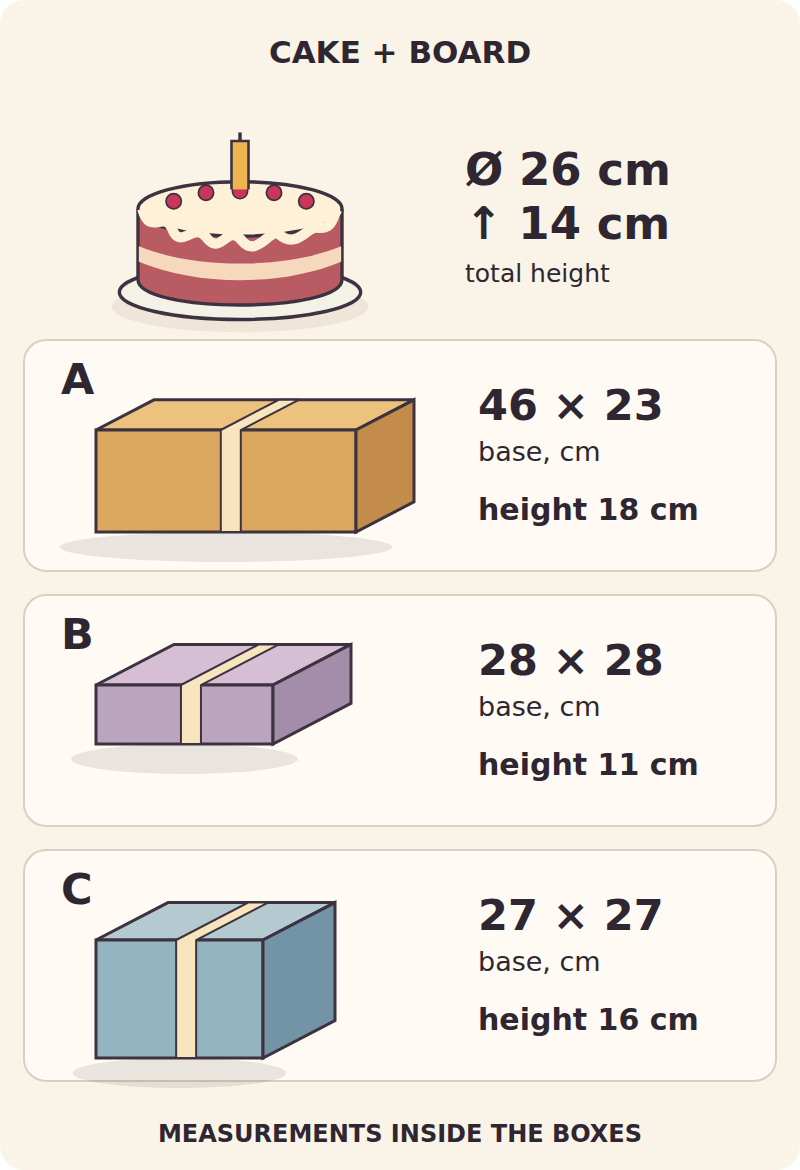
Which box do you take?
The drawing and caption give you every measurement you need. Pick the wrong box? You can come back.
The guests have not noticed yet
Grandma has a plan. You have three boxes. Which one goes downstairs?
Some clues are heavier than others
You pick up the long box. Something heavy rolls inside. Cakes do not do that.
“Those are dumbbells,” your uncle calls from the dining room. “Like I said, life begins at eighty.”
The box is large, but only 23 centimetres wide. The round board needs 26. Turning a circle diagonally cannot make it narrower. The whole cake cannot fit.
You carefully put the present back in the returns queue. Apparently Grandma had one more reason to escape.
An almost perfect plan
The wide box looks promising. But Grandma would never flatten her own cake for the sake of secrecy.
It has only 11 centimetres of room inside. The cake, board and decoration need 14. Cutting off the top or laying the cake on its side is not allowed.
A returns label peeks out from one side: “Pyjamas. Wrong size.”
Someone asks where the birthday girl has got to. “She's working on something,” you say. It is not entirely untrue.
Two tickets, one cake
Box C has a 27-by-27-centimetre base, enough for the round board's diameter of 26. Its height is 16, leaving room above the 14-centimetre cake. The other boxes fail on width and height.
You carry it downstairs. Grandma is outside in trainers. Beside her are Lida from the ground-floor flat, two suitcases, and a taxi with its boot open.
“Lida has a train to the seaside,” Grandma says. “Now I do too. I asked for a window seat.”
“What about the guests?”
“The first speech usually takes forty minutes. We'll make it.”
She lifts the lid. The cake is intact. In the icing, she has written: “At last.”
“All mine,” she says. “The cake. The birthday. The window seat.”
Grandma hands you a folded note for the guests. Then she glances at the front door.
“Will you give them that now? Or give us a little head start?”
A short speech
Back at the table, you unfold the note.
“Lida and I are off to the seaside. Don't worry. I took the cake. You can have the salad. G.”
For a few seconds, the refrigerator motor is the only sound.
“What are we supposed to do now?” asks your uncle.
Grandad folds his three pages in half, takes out his phone, and records a voice message.
“Have a wonderful trip.”
His first short birthday speech reaches Grandma before she reaches the station.
Just a few words
You return to the table and ask to speak.
“Before we call Grandma in, I'd like to start at the very beginning.”
Your uncle nods appreciatively. He recognises a professional.
Under the table, your phone buzzes. “On board.” You move on to her schooldays. Another message: “We're off.” You recall summers in the country.
When Grandma sends a photograph of the cake on the train's little table, you take out her note.
“And now,” you say, “at last, the important part.”
Through the window in her photograph, the city is already falling behind.